0% and interest-free business credit cards: what actually exists in the UK
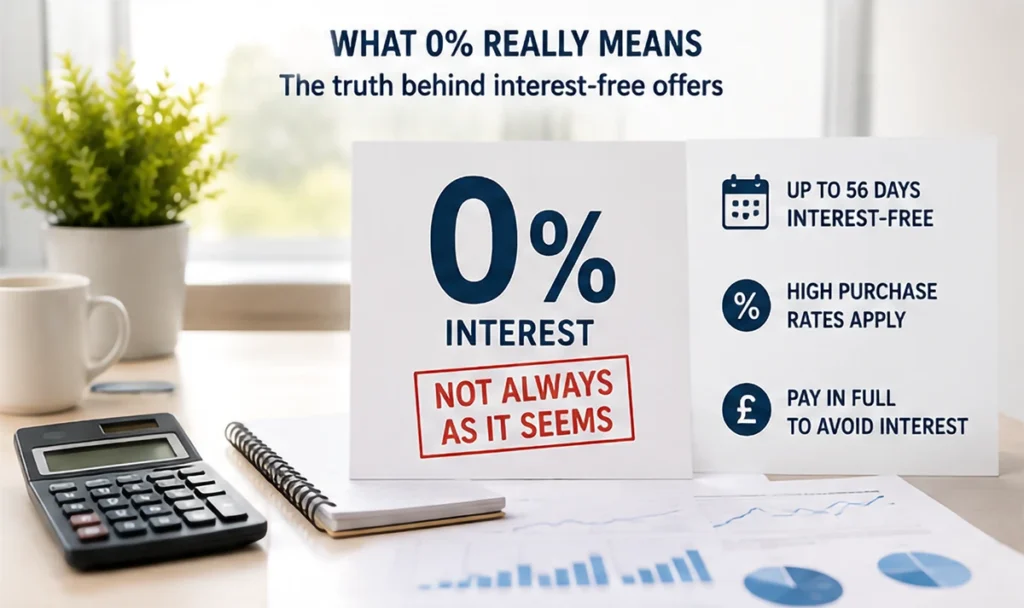
graphic shows an overview of 0% interest

If you’re looking for a business credit card with a 0% purchase period, the short answer is that among the 15 UK business cards we track, none publishes one. None publishes a balance-transfer offer either. What every one of them offers instead is the ordinary interest-free window on purchases, usually quoted as “up to 56 days”, and that window does more work than most people realise. This guide explains what it is, what the rates look like when you do carry a balance, and what that balance costs you.

Why 0% business cards barely exist

Consumer credit cards compete on 0% periods because the lender expects to make money later, when the promotional rate ends and a share of cardholders keep a balance. Business cards are a different market. Limits are set against the company and usually a director’s personal guarantee, balances are larger, and issuers would rather earn from interchange and annual fees than fund a year of free credit.

So the offers that do exist on business cards are cashback and points, not 0% interest. Funding Circle’s card pays 2% cashback for six months, capped at £2,000 of cashback, then 1%. Capital on Tap and Amex compete on rewards. The “0%” that turns up in searches is nearly always a US card, where the market works differently.

For a business, the question behind a search for 0% is often not really about finding a particular card. It is about the cost and length of borrowing. A credit card’s normal interest-free period can provide useful short-term cash-flow flexibility when purchases are paid off in full, but it is not a substitute for longer-term working capital. If a business expects to carry the balance for several months, the purchase rate and the cost of alternative finance matter more than the rewards attached to the card.
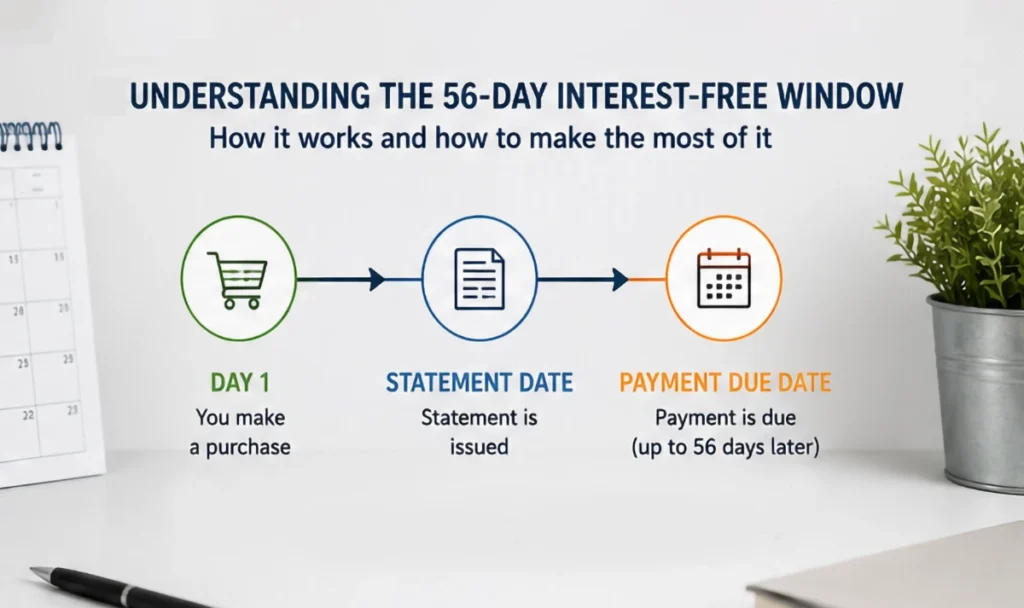
understanding upto 56 days interest free window

What “up to 56 days interest-free” means

Every credit card in our list charges no interest on purchases if you pay the statement in full by the due date. The “up to 56 days” is the longest gap you can get between a purchase and the payment date: buy on the first day of a statement period, get the statement at the end of the month, pay up to 25 or so days later.

Two things follow. First, the average purchase gets roughly half that, not 56 days. Second, it is interest-free only while you clear the balance every month. Pay even part of it late and interest is charged on the whole balance from the transaction date, at the card’s purchase rate. That is the rate the rest of this guide is about.

Lloyds and the NatWest and RBS card are the two we have sourced a published 56-day maximum for; the rest describe the same arrangement without putting a number on the longest case.

Amex’s Business Gold and Business Platinum are charge cards, where paying in full each month was the condition of holding one. Since January 2026 both carry an optional pay-over-time facility, and both publish a 29.1% purchase rate on it. The BA Amex business card is an ordinary credit card, at 26.6%.

Purchase rate and representative APR are different numbers

This is where business card marketing is at its least helpful. Issuers publish two rates, and they are not interchangeable.

The purchase rate is the interest actually charged on a carried balance. The representative APR is the regulated headline: it includes the annual fee, assumes a £1,200 credit limit, and is the rate at least 51% of accepted applicants must get. For a card with no fee the two are close, and Barclaycard’s are identical at 25.5%. For a card with a fee they can be wildly apart: BA’s Amex business card has a purchase rate of 26.6% and a representative APR of 104.9%, because £250 a year against a £1,200 limit dominates the calculation.

A fee is not the only thing that separates them. Funding Circle charges nothing a year and publishes “rates from 14.9%” alongside a representative 34.9% APR. The 14.9% is the floor. The 34.9% is what most accepted applicants get or better, and it is more than double the number in the headline.

Some issuers publish no representative figure at all. Capital on Tap’s “rates as low as 13.86% APR” is a floor with nothing published next to it. We show a “from” rate as exactly that, in the table below and on every card in the calculator.

CardPurchase rateRepresentative APRTypeAnnual fee
Capital on Tap Free Rewards13.86% (a “from” rate)not publishedCredit card£0
Capital on Tap Pro13.86% (a “from” rate)not publishedCredit card£299
Funding Circle Cashback Card14.9% (a “from” rate)34.9%Credit card£0
Lloyds Business Credit Card14.9%15.95%Credit card£0 in year one, then £32
RBS / NatWest Business Card16.9%24.3%Credit card£0 in year one, then £30
Metro Bank Business Card17.44%18.9%Credit card£0
Santander Business Cashback18.9%23.7%Credit card£30
Barclaycard Select Cashback25.5%25.5%Credit card£0
Amazon Business Amex26.4%37.6%Credit card£0 in year one, then £50
Amazon Business Prime Amex26.4%37.6%Credit card£50
BA Amex Accelerating Business26.6%104.9%Credit card£250
Amex Business Gold29.1%not publishedCharge card with a pay-over-time option£0 in year one, then £195
Amex Business Platinum29.1%not publishedCharge card with a pay-over-time option£650
Mossnot publishednot publishedCharge card£0

Purchase rate is what interest is charged at on a carried balance. Representative APR is the regulated headline, which includes the annual fee on an assumed £1,200 limit. A “from” rate is the issuer’s best case, not what most applicants get. Sources and dates for every figure are on each card in the calculator.

What a “from” rate actually means

A rate advertised as “from 14.9%” is the lowest rate available, not necessarily the rate most applicants will receive. The actual rate offered can depend on the business’s financial position, trading history, credit profile and the lender’s assessment of risk.

Advertised figure
What it means
“From 14.9%”
The lowest rate available to qualifying applicants
Your offered rate
The rate the lender decides to offer your business after its assessment
Representative APR
A regulated figure showing the rate that at least 51% of accepted applicants are expected to receive or beat, where the issuer publishes one

For a business comparing cards, the important distinction is that a “from” rate should not be treated as a promise. If you expect to carry a balance, compare the realistic rate you may be offered rather than assuming you will qualify for the lowest advertised figure. A card with an attractive headline rate can become significantly more expensive if your actual rate is higher.

The lowest business credit card interest rates

If you carry a balance, rewards stop being the thing that matters. Here is the calculator’s carry-a-balance mode at £5,000 a month, with about one month’s spend carried and interest charged at each card’s purchase rate:

#CardFirst-year valueOngoing /yrInterestRewardsFee
1Funding Circle Cashback Card£155−£145−£745£900£0
2Capital on Tap Free Rewards−£93−£93−£693£600£0
3Capital on Tap Pro−£292−£392−£693£600−£299
4Santander Business Cashback−£375−£375−£945£600−£30
5Lloyds Business Credit Card−£445−£445−£745£300£0
6BA Amex Accelerating Business−£574−£824−£1,330£756−£250
7Barclaycard Select Cashback−£675−£675−£1,275£600£0
8Amex Business Gold−£767−£1,122−£1,455£528£0

At £5,000 a month, carrying about one month’s spend as a balance, so interest is charged at each card’s purchase rate. Default spend mix, no perks counted. Live output of the same formula as the calculator.

Look at the minus signs. One card is ahead after a year, and only because of an introductory offer: Funding Circle’s 2% for the first six months roughly covers the interest it charges over the same period. Its ongoing line is negative like all the others. At this spend, a carried balance costs more than any of these cards pay back, and the question is which loses least.

On rate alone, the order is:

  • Capital on Tap, “as low as 13.86%”, with no representative figure published
  • Lloyds at 14.9% (representative 15.95% APR variable, the closest thing here to an honest headline)
  • Funding Circle at 14.9%, but a “from” rate with a representative 34.9% APR variable
  • NatWest and RBS at 16.9% (representative 24.3% APR variable)
  • Metro Bank at 17.44% (18.9% APR, and Metro says every customer pays the same rate)

Access is the catch. Lloyds and Metro each need one of their own business current accounts, and Funding Circle wants a limited company with 12 months’ trading and £30,000 turnover.

NatWest, RBS and Metro sit low in the table above rather than high, despite those rates. Their cashback is paid on fuel and EV charging only, which the calculator does not yet model, so they earn nothing in the default spend mix and carry the interest cost alone. If most of your spend is fuel, they will do better for you than the table shows.

If you need to borrow for longer than a month

A credit card at 14.9% is an expensive way to borrow for a year. If the real need is working capital rather than a payment tool, the honest answer is a business overdraft or loan, which we don’t compare and don’t link to. Use a card for what the interest-free window is good at: a month or two of float on purchases you’d be making anyway, paid off in full.

The calculator asks whether you usually pay in full. Answer it honestly. It switches the ranking to lowest cost if you say no, and that single answer changes which card wins more than anything else you tell it.

What we checked. Issuer product pages and summary boxes for all 15 cards, read live on 19, 21 and 22 Aug 2026: Santander, Lloyds, Metro Bank (including its Feb 2024 Important Information Summary), NatWest and RBS, Barclaycard, Funding Circle, Capital on Tap, Amex (Gold, Platinum, BA), Amazon Business (both cards), Moss and Juni. Every card had at least one figure we corrected: Funding Circle’s representative 34.9% and Amex Platinum’s 29.1% pay-over-time rate were both sourced on 22 Aug 2026. The working is in our verification notes on /methodology.

Ready to see your own ranking? Run the card calculator at /cards.